


For years, most travel technology innovation was focused on one question:
How do we make booking easier?
Flights became searchable in seconds. Hotels moved online. Reviews became universal. Maps became extraordinarily good. Today, artificial intelligence can build a multi-day itinerary before you have even decided what to pack.
That part of the travel journey is becoming increasingly efficient.
But I think the more interesting question now is what happens after the traveler arrives.
Because booking a destination and experiencing a destination are two very different problems.
Recent developments across travel technology suggest that the industry is beginning to move in exactly that direction.
AI is no longer being used only for inspiration. Research from Phocuswright shows European travelers increasingly using AI throughout the journey, including decisions made while already at the destination. Expedia is integrating conversational planning more deeply into its ecosystem, while Amadeus describes travelers mixing AI tools and travel apps to build increasingly personalized journeys. phocuswire.com
The technology is becoming better at answering:
Where should I go?
Where should I stay?
What should I do tomorrow?
The next opportunity is helping travelers answer:
What should I experience right now, standing exactly where I am?
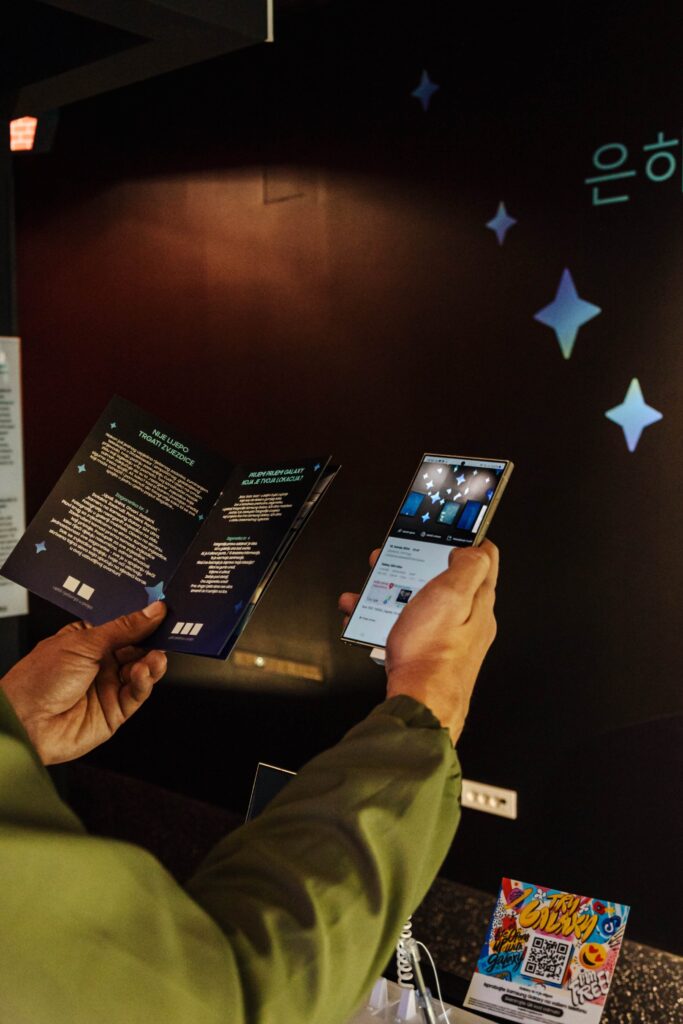
From information to context
Travelers do not suffer from a lack of information anymore.
If you stand in front of a cathedral in Rome, a palace in Madrid or a square in Zagreb, you can instantly find its construction date, architectural style, reviews, photographs and historical facts.
AI can summarize all of it.
That means simply providing more information is becoming less valuable.
What remains valuable is context.
Why does this place matter?
What am I looking at?
What would a local notice that I would probably walk past?
What happened here that makes this location interesting?
That distinction is important.
The technology layer of travel is moving from being an information database toward becoming an experience layer.
And that changes the kinds of products we should be designing.
AI will plan more of the journey — but people still want people
One of the most interesting tensions in travel technology right now is that AI adoption is accelerating while trust remains a constraint.
Skift’s 2026 research describes AI as moving from novelty toward habit in trip planning, while still highlighting traveler hesitation around allowing AI to make consequential decisions on their behalf. Expedia similarly reports that travelers are comfortable using AI for suggestions, while trusted brands remain important when it comes to actually acting on those recommendations. Skift Research
I think that tells us something important about travel.
People want technology to remove friction.
They don’t necessarily want technology to remove humanity.
Those are very different things.
For example, an AI system can tell a traveler which ten places they should see in Amsterdam.
But once that traveler is standing beside a canal, the memorable part may still be a real person explaining why that particular street feels different from another one.
Technology can decide what is relevant.
Humans are still extremely good at explaining why we should care.
Creator-led travel is becoming infrastructure
Another development worth watching is the growing role of creators in travel discovery.
For a long time, travel companies treated creators primarily as a marketing channel.
A creator produced a video, the video generated reach and the campaign ended.
That model is changing.
Skift has been highlighting a broader move toward creator-led travel demand, while Airbnb has been actively recruiting creators into its Experiences business. In other words, creators are moving from simply promoting travel products toward becoming part of the product itself. Skift
That is a significant shift.
A person who knows a neighborhood, tells stories well and already has an audience can provide something that a traditional database cannot easily reproduce: perspective.
For travel technology companies, the question becomes:
How do we turn that human perspective into something scalable without removing the personality that makes it valuable?
I suspect this will become one of the major product questions of the next few years.

Video will increasingly sit between discovery and experience
Video already dominates travel inspiration.
People discover restaurants, beaches, neighborhoods and hotels through TikTok, Instagram, YouTube and creator content.
But most travel video is still disconnected from the physical journey.
You watch a video before traveling.
Then you arrive.
Then you switch to Maps.
Those experiences barely communicate with each other.
I think that separation will increasingly disappear.
Imagine content that understands where you are.
A creator doesn’t just make a video called Five things to see in Zagreb.
Instead, the video appears when you are standing in the exact location where the story matters.
The content becomes part of the environment.
That is a fundamentally different use of video.
It moves from travel inspiration to location-based interpretation.
And once that happens, GPS, video, creators and AI start becoming parts of the same product ecosystem rather than separate technologies.
The self-guided experience is becoming much more sophisticated
Historically, “self-guided tour” often meant one of two things:
a printed map or an audio guide.
Both are useful formats, but mobile technology makes much more possible.
A modern self-guided experience can understand location, sequence content, use video, provide navigation, adapt recommendations and potentially respond to what a traveler wants to do next.
This is one of the reasons we have been experimenting with the concept through products such as Tourizzy, a GPS-guided video walking tour platform where travelers discover cities through short location-based videos created by local guides and storytellers.
The interesting part for me isn’t simply the application itself.
It is the broader behavior behind it.
Travelers increasingly want:
guidance without rigid schedules,
local knowledge without necessarily joining a group,
and technology without losing the human voice.
That is a much larger trend than any single product.
Hotels could become experience gateways
There is another part of travel technology that I think is still underdeveloped: the relationship between accommodation and destination experience.
Hotels know exactly when a traveler arrives in a city.
Yet once the guest leaves reception, the hotel often becomes disconnected from the rest of the experience.
A guest asks:
What should I see this afternoon?
And the answer is frequently still a paper map, a verbal recommendation or a list of attractions.
There is a huge opportunity here.
Hotels could become digital gateways into destinations.
A QR code in a room could open a neighborhood itinerary.
The hotel app could provide a local walking experience.
Recommendations could adapt to the guest’s available time, weather or interests.
The hotel does not need to become a tour operator.
It simply needs to become a better interface between the guest and the city.
As personalization becomes a larger part of hospitality technology, this relationship will become increasingly important. Booking.com’s 2026 travel research places strong emphasis on more individualized travel, while Amadeus highlights increasingly personalized hotel stays as one of the major trends shaping travel.
Search itself is changing the travel distribution model
There is also a less visible change happening.
For years, travel discovery was heavily structured around search engines and large booking platforms.
A traveler typed:
“Best walking tours in Barcelona.”
They received ten blue links.
Increasingly, the interaction looks more like:
“I’m staying near Plaça de Catalunya, I have three hours before dinner and don’t want to join a group. What should I do?”
That is an entirely different interface.
AI systems can interpret intention, time, location, preferences and context simultaneously.
This creates a major challenge for travel brands.
Being number three on Google for a keyword may become less important than being a product that an AI system actually understands well enough to recommend.
The brands that benefit will be those that clearly communicate what they are, who they are useful for and what makes them different.
This is particularly relevant for smaller travel technology companies.
They may not have the advertising budgets of global travel platforms, but if their product solves a very specific traveler problem, conversational discovery could make them easier to surface.
The winners will remove friction without removing discovery
There is a risk in all of this.
Travel can become too optimized.
If an algorithm selects every restaurant, every route and every attraction, the traveler risks experiencing exactly what was predicted for them.
And some of the best parts of travel happen when the plan goes wrong.
A street you weren’t supposed to walk down.
A café you hadn’t researched.
A conversation you hadn’t scheduled.
So I don’t think the best travel technology should attempt to control the entire journey.
It should remove unnecessary friction while leaving enough space for discovery.
That principle influences a lot of how we think about digital products at artivio; Studio.
Technology should provide the useful layer:
orientation, context, access and personalization.
Then it should allow the real-world experience to remain the main event.
Travel tech is becoming experience tech
The booking revolution has already happened.
The AI planning revolution is happening now.
The next phase will be about what occurs between the itinerary and the memory.
How do travelers interact with a destination?
How does digital content respond to location?
What role do creators play?
How do hotels remain useful after check-in?
How do we personalize without making every journey feel algorithmically identical?
Those questions are where travel technology becomes much more interesting.
Because ultimately, travelers do not remember the interface they used to book a trip.
They remember what happened when they arrived.
And the best travel technology of the next decade will probably be the technology that understands that distinction.